The year 2021 will mark the 100th anniversary of what may be considered the earliest domestic attack on U.S. soil in the history of the United States. The attack happened in what was known as Black Wall Street – the Greenwood Business District in Tulsa, Oklahoma. The violent attack changed the lives of victims and their families as the community is still recovering after almost a century.
The Deep Deuce District in downtown Oklahoma City, Oklahoma endured a silent attack through legislation and state mandated laws that also impacted their community. The effect of gentrification gradually moved African Americans out of the downtown areas in both cities.
Racial unrest has caused the dissemination of families and communities across many lines. The line of segregation divided African Americans from mainstream America to live in designated neighborhoods.
Recent measures taken in the “Me Too” movement and Colin Kaepernick’s stance for racial equality brought forth a new sounding board for a few social ills that may have been kept silent for decades. Feminists’ marches and racial protests are woven in American culture.
Last month, on Juneteenth, The Atlantic published a story about Ta-Nehisi Coates’ testimony to the House Judiciary Committee on reparations for African Americans.
The article mentions Black Wall Street, stating that “if D-Day matters, so does Black Wall Street.” The question for Oklahomans has been, do state and government officials make fair political and economic decisions concerning people of color?
Class and race relations in the United States can be seen through many faces including the faces of those affected by urban renewal projects and the Tulsa Race Massacre of 1921 in Oklahoma. Segregation, urban renewal, and the Tulsa Race Massacre are all reflections of the dividing line.
Segregation in Oklahoma
During the time of segregation in Oklahoma, many African Americans lived primarily in two thriving communities; Deep Deuce District in Oklahoma City and Black Wall Street – Greenwood District in Tulsa.
The Deep Deuce District in Oklahoma City produced Oklahoma Jazz Hall of Fame Guitarist, Charlie Christian and a slew of other talented artists and musicians. Both communities were a mecca for African American doctors, lawyers, business owners, and skilled workers.
The two communities shared similar lifestyles under segregation laws, but one neighborhood met disbandment through civil means and the other faced uncivil attacks that left its affect on families still after almost a 100-year later.
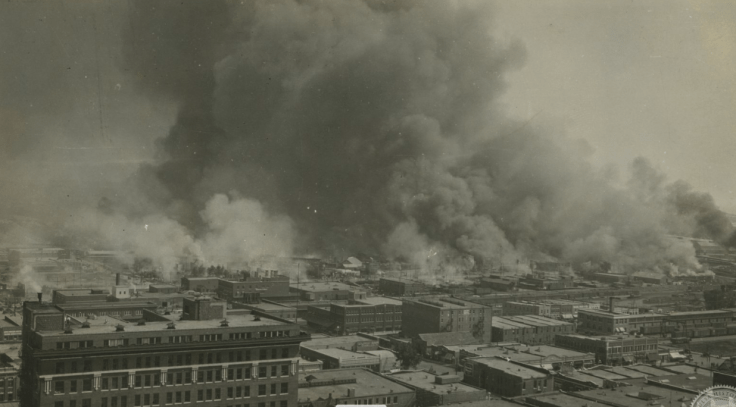
The Tulsa Race Massacre
In 1921, White Tulsans attacked the African American residents in the Tulsa Greenwood business district with air bombs, gunfire, and fires. Like the Deep Deuce District in Oklahoma City, the Black Wall Street District in Greenwood was self-sufficient with their (own) bankers, doctors, lawyers, and business owners. The violent attack left an estimated 300 African Americans dead. The damage to personal property and 35 blocks of real estate left about 10,000 homeless. For decades many of the remaining residents did not speak about the violence.
“What our survivors have said was that it was too painful to talk about, so they did not tell their children and grandchildren about the massacre,” said Greenwood Cultural Centers’ Program Director, Mechelle Brown. “But also, surprisingly, they did not want their children and grandchildren to judge people based on the history. They wanted them to judge them based on their character,” Brown commented.
The race massacre was rarely talked about and was left out of Oklahoma history books until now. In February 2018, Oklahoma Legislators announced a new plan to add the history of the Tulsa Race Massacre to the state’s school curriculum. The curriculum will be made available to teach, but it will be optional. It is not required.
Urban Renewal
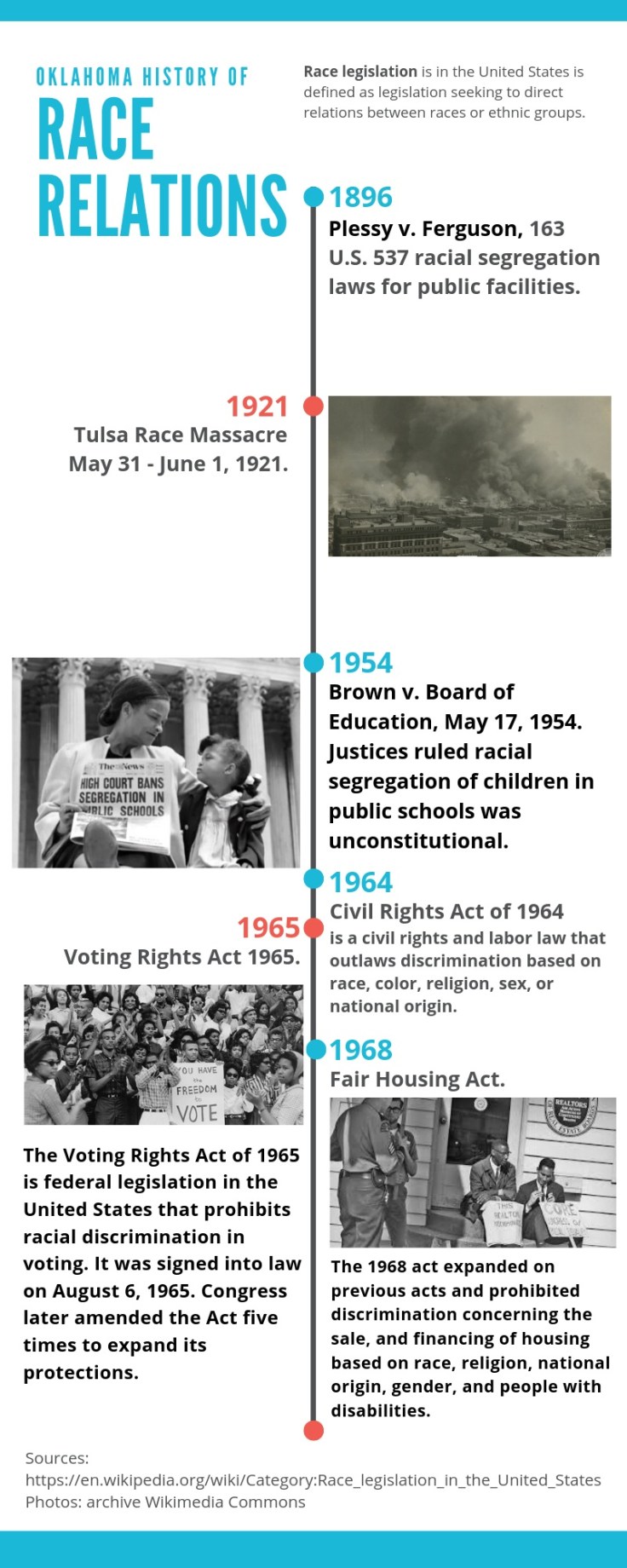
The Fair Housing Act of 1968 allowed African Americans to move outside of designated neighborhoods, but gentrification and urban renewal made it difficult for many families to keep their homes and businesses or to find decent and affordable housing.
Essentially, urban renewal projects are designed to clean up and rebuild dilapidated buildings and reconstruct underused segments of inner-city neighborhoods, but Bruce Fisher with the Oklahoma Historical Society feels that urban renewal has not been a good thing for the African American community.
“They feared urban renewal because they knew that urban renewal had the power of eminent domain,” Fisher said. “They knew when they came in with a fair market value offer for the houses, that they would literally have to take it or leave it,” he continued. “If they sold their house for fair market value, they couldn’t afford to go to the new neighborhoods and buy a house with the money they had for the sell of their house, so it was a bad deal for our community.”
Native Oklahoman, Carlos Reynolds, experienced the affects of urban renewal and gentrification first-hand; his Father was a black owner of a barbershop on Walnut and 2nd Street in the Deep Deuce District.
“It’s been very sad to watch the decline of that area,” Reynolds said. “You can’t even hardly tell the areas now because there’s nothing in honor of the blacks, of the people who built that particular area. Due to gentrification, all you see are restaurants and town homes and things like that. It’s very sad to see,” he said. “The thing about it, the people who grew that area, the blacks who grew that area, are no longer there. Their families are no longer there. It is completely white owned,” Reynolds stated.
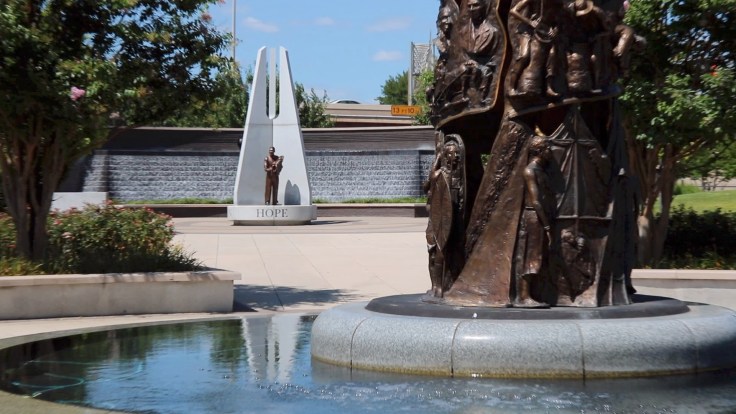
The Present
Reconstruction of the Greenwood District includes the ONEOK minor league baseball stadium, the John Hope Franklin Reconciliation Park, a block of storefront businesses on Greenwood Avenue and Archer Street, and the Greenwood Cultural Center. The center offers tours and displays photos that tell the story of the district’s heritage. State and city officials are planning a commemorative event in remembrance of the race massacre in 2021.
Dr. Ricco Wright is the Artistic Director for the Black Wall Street Gallery. Wright developed the gallery’s Conciliation Series that pairs a black artist with a white artist to create a work of art. The gallery supports a diverse group of talented artists. He hopes to bring positive change and unity to the community. One of Wright’s challenges is to get people to patronize the businesses.
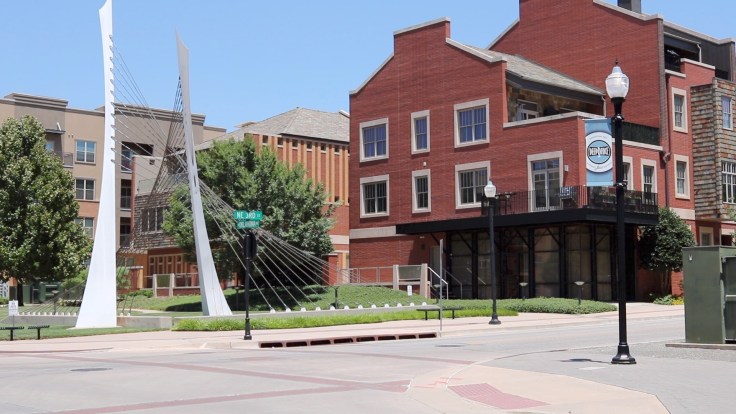
The transformation of the Deep Deuce District brought a host of restaurants, lofts, apartment complexes, hotels, a trolley system, and various entertainment venues.
Today, there are a number of affluent African American communities across the United States; the Mid-Atlantic region of the east coast and the Western region house the highest concentration of wealthy African American neighborhoods.
 Variety News
Leave a comment